The tale of diamonds is as old as time itself, it speaks of a stone that has captured the collective human imagination and touched a myriad of cultures, societies and human civilisations for over a millennia. The perennial presence of this unique stone has etched its part into the theatre of time and history, and has breathed life into itself as an active entrant in this grand drama. The stone stands as a symbol of time, through its enduring and unwaning nature that touches on the borders of the realms of the infinite and the transcendent. A living artefact that binds past and present, an adamantine thread of time that spreads itself into every crack and crevice, nook and cranny of the continuously unfurling tapestry of human consciousness.
The Williamson Pink Star is one such stone that speaks to this intimate journey through time, further cementing diamonds as the bearers of history, acting as eternal enduring symbols of these histories and as time capsules in themselves. The stone is named in homage to two preeminent pink diamonds, the first is the celebrated ‘Williamson stone’, a pink diamond presented as a wedding gift to Her Late Majesty Queen Elizabeth II in 1947 by Canadian geologist and royalist Dr. John Thorburn Williamson. One of the Queen’s favourites, the stone originated in the Williamson mine in Mwadui, Tanzania. It was established and once owned by its namesake Dr. Williamson, where it started operations in 1940 and was one of the oldest diamond mines in the world. It is reputed for producing fine ‘bubblegum’ pink diamonds. The Williamson stone was refined from a rough stone of 54.50 carats into a 23.60-carat round brilliant-cut diamond. The pink stone was mounted as the centrepiece of a floral brooch designed by Frederick Mew of Cartier in 1953, where the late Queen has worn it on numerous occasions, including the Silver Jubilee. The second diamond referenced in the name is the Pink Star Diamond that was auctioned at USD$71.5 million sold to Chow Tai Fook, back in April 2017 weighing 59.60 carats, being the fifth most expensive diamond in the world, and it still holds the world auction record for any diamond, gemstone or jewel.
The Williamson Pink Star belongs to the class of Fancy Colour Diamond, the colour pink is the 3rd rarest colour to appear on diamonds, as all the diamonds submitted to the Gemological Institute of America (GIA) less than 3% are classified as coloured diamonds, and less than 5% of those are considered permanently pink. Moreover, most pink diamonds fall into the spectrum between Faint Pink to Fancy Pink, and only a few have a strong face-up colour that can be described as Fancy Vivid Pink, and those are often small in size. Hence, this is an extremely rare case for a Fancy Vivid Pink Diamond to weigh over 10 carats, and for the Williamson Pink Star, which weighs 11.15 carats. For instance, in 2018, the GIA selected a sample of 1,000 pink diamonds from their database of coloured diamonds graded between 2008 and 2016, and found that 83% weighed less than 1 carat. Thus, in further elaboration of the rarity and uniqueness of the Williamson Pink Star, an excerpt of the GIA letter states that, “…The Williamson Pink Star Diamond is among the rarest of all gemstones… Attaining a Fancy Vivid color grade with pink diamonds in their size requires a very strong inherent body color in the rough crystal. It is unusual for pink diamonds to occur with a strong depth of color or saturation in any size…In addition to its exceptional color, the clarity is Internally Flawless – a special combination. Examples such as this are some of the rarest gems ever discovered.”
In addition, the Williamson Pink Star is the second internally flawless Fancy Vivid Pink diamond weighing over 10 carats to go on auction. It has received the highest colour and clarity grades. It is also a type IIa diamond with no measurable trace elements like nitrogen or boron impurities, making it one of the most chemically pure diamonds. Only less than 2% of diamonds fall under this category. Studies have found that trace elements have never been found in pink diamonds, and that the colour is caused by a distortion in the diamond’s crystal lattice, created by intense heat and tremendous pressure from all directions, also known as non-isotropic stress. Thus, the colour pink is produced due to distress at the atomic level.
Already there is a history that dates back to the late twentieth century. Yet, the very nature of diamonds is that of deep time, and they are the closest physical symbols and objects that represent notions of the eternal and the infinite. Diamonds have origins dating back 3 billion years, taking approximately 1-3 billion years to form naturally. The earth is 4.543 billion years old, the formation period of diamonds is around three-quarters of the earth’s age. These stones are born of carbon, the strongest element known to humanity. They are forged under immense pressure and heat, 500 kilometres beneath the earth’s surface, within the mantle region of the planet, which is 2,900 kilometres from the surface. The British monarchy has a history of 1,209 years with 37 generations tracing from Queen Elizabeth’s bloodline. If calculated from the establishment of absolute monarchy in England, it would start from 1066 after the Norman conquest of England, following from the successful military campaign of the Battle of Hastings, which would give the age of the British monarchy that of 959 years counting from this year of 2025, almost a millennium. Compared to Britannia’s former coloniser, the Roman Empire lasted from 753 BCE to 476 CE, was 1,229 years, well over a millennium. Hence, the age of diamonds may well span the ages of empires and their passings, where the imperial legacies live on through these stones till this very day. From the early days of their formation to their unearthing, in which they have been worn by royalty and thus became the indisputable symbols of power and the “everlasting” nature of Empires, and with their passing comes to tell the tales of those bygone eras where those periods lives on through these brilliant, starlike ancient stones.
There is also a sense of timelessness and resilience in the commercial value of diamonds, particularly in the case of the Williamson Pink Star, which is connected to the late British monarch. Tobias Kormind, the managing director of London jewellery shop 77 Diamond remarked that “This [the auction performance of the Williamson Pink Star] is an astounding result, proving resilience of top diamonds in a shaky economy.” He further remarked that “Hard assets such as world-class diamonds have a history of performing well even in times of instability” and that “[s]ome of the world’s highest quality diamonds have seen prices double over the last 10 years.” As demonstrated in the recent 2017 Sotheby’s Hong Kong auction of this “top diamond” and “world-class diamond” there seems to be an eternal allure and charm to this stone. Further highlighting the rarity of the Williamson Pink Star, Wenhao Yu, the Chair of Jewellery and Watches at Sotheby’s Asia said, “The discovery of a gem-quality pink diamond of any size is an extremely rare occurrence, something that – with the current closure of the Argyle mine – seemed, until recently, highly improbable.”
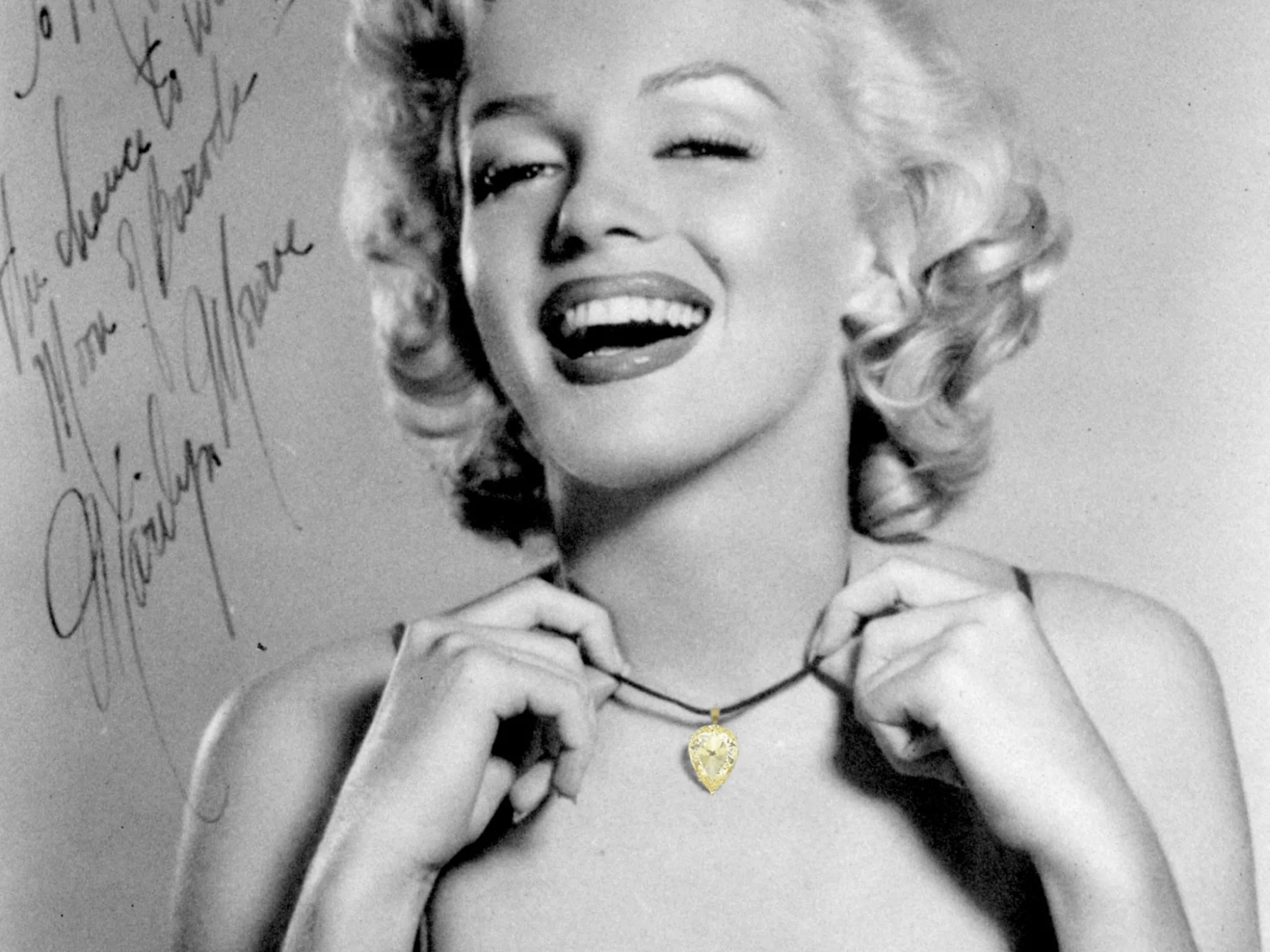
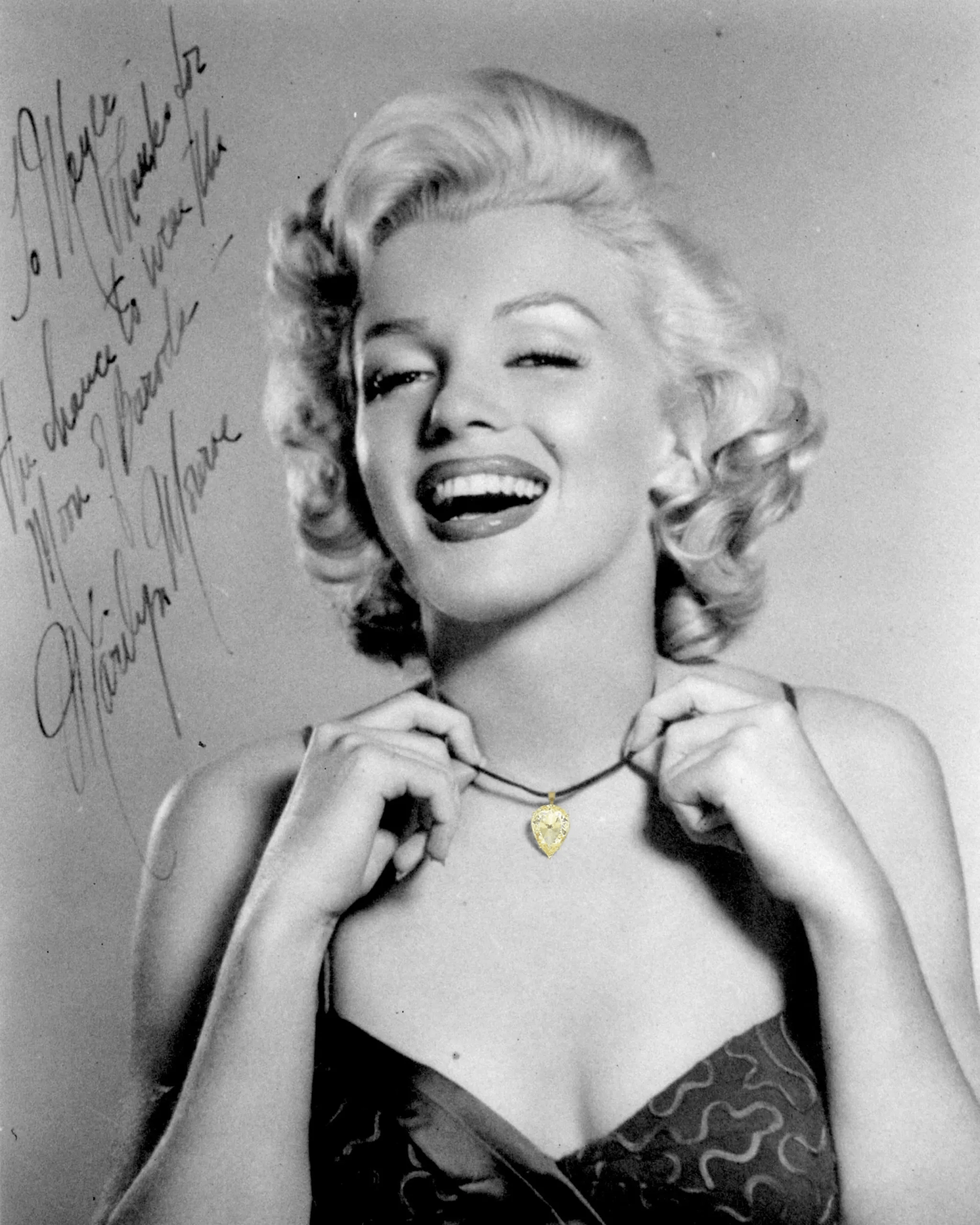
Speaking of diamonds’ legacies through their contact with Empires and royalties, the Moon of Baroda arguably known as the Monroe Diamond has found it temporary resting place in the city of Hong Kong, as the stone was expected to fetch around HKD$4-6 million (USD$512,700-769,050) at the 2018 Christie’s Hong Kong auction Magnificent Jewels Sale presented along with a photograph of Marilyn Monroe wearing the diamond necklace, signed by herself. Yet this diamond has traversed across history from pre-colonial India to modernity and the present moment. This precious stone has rolled through the waves of the vast tumultuous oceans of imperial and modern history and deep time, passing through many hands and periods. The timeless beauty and eternality of this stone is reflected in the lyrics of Marilyn’s song Diamonds Are a Girl’s Best Friend in her 1953 film Gentlemen Prefer Blondes, that “Men grow cold / As girls grow old / And we all lose our charm in the end / But square-cut or pear-shaped (referencing the Moon of Baroda) / These rocks don’t lose their shape”. In Marilyn’s breakout film, as mentioned above, she certainly over the course of her Hollywood career has crafted herself as irrevocably as the “Queen of Hollywood” and the unequivocal “crown” she has on the Hollywood industry. The power and chokehold she has on the force that is Hollywood – like the choker of diamonds adorned on her neck in her debut film. As seen in the case of Marilyn Monroe and the Moon of Baroda, there is a royal and imperial marriage between the stone and the cultural icons and royalties within society. The eternal brilliance and beauty of the stone, becomes the very symbol of the legacies of these legendary figures that have left an indelible and perennial impact on our collective history, and the symbol of the diamond is that light that shines forever. This light does not dim or fade. This sense of the durable commercial success of diamonds lasting through the ages, and their being the symbol that embodies the eternal, echoes in the sentiments by Tobias Kormind, managing director of 77 Diamond and Wenhao Yu, Chair of Jewellery and Watches at Sotheby’s Asia, which were cemented by the social marketing of these stones back in 1948 by De Beers in their “A diamond is forever campaign”, demonstrates the endurable consistency of the narrative of the timlessness of diamonda, from the colonial age to the modern period.
Thus, the histories between diamonds and Empires are inseparable, and the stone is the only historical artefact of commercial value accessible to the modern public, where it has journeyed through the golden halls of monarchies and bygone ruling imperial dynasties. Hence, possessing these stones is akin to possessing the last remnants of Empires, and having a piece of that history that is still intact after so many centuries. The Moon of Baroda was discovered and unearthed in the rich diamond mine of Golconda, India, weighing 25.95 carats when found near Hyderabad sometime between the 1500s and the 1700s. The natural rough diamond first travelled to the Western city of Baroda (modern-day Vadodara). At Baroda, the diamond’s fancy yellow colour and high clarity nature was meticulously crafted into a pear-shaped 24.04 carats diamond, ideally suited for the royal “pagri” (royal headgear) of Indian nobility. The mere 0.99 carat weight loss also represents the excellent Indian craftsmanship given historical cutting techniques.
Like many historical artefacts and treasures, the stone has been passed through the hands of many imperial dynasties. In its early days, the stone has sparkled in the treasure vaults of Mughal Emperor Muhammad Shah in Delhi. In 1739, Nadir Shah of Persia raided Delhi and looted it with legendary treasures like the Kohinoor Diamond and the Peacock Throne, now part of the Royal Iranian collection. However, for most of its near five centuries known history, the stone remained in possession of the powerful Gaekwads of Baroda, an Indian dynasty of the Maharajas, who for two centuries ruled much of Western India that is now centred around the modern state of Gujarat, known historically for its prosperity and affluence in the region. The Gaekwads, initially believed to have the surname “Matre”, trace their lineage to the Maratha clan, esteemed as Kshatriyas, the military and warrior caste in pre-colonial India. The Gaekwads are a Hindu Marathi dynasty of the former Maratha Confederacy and its subsequent (erstwhile) princely state of Baroda in Western India from the early 18th century until the Partition of India in 1947. The ruling prince was known as the Maharaja Gaekwad of Baroda, with the city of Baroda (Vadodara) as its capital, and during the British Raj its relation with the British was managed by the Baroda Residency. Baroda (Vadodara) was one of the largest and wealthiest princely states existing alongside British India, with wealth coming from a lucrative cotton business and rice, wheat, and sugar production.
The Moon of Baroda was kept alongside the impeccable artworks, handmade rugs, golden sculptures, and the many treasures that filled the golden regal vaults of the Gaekwads. It was so famed that it was rumoured to be second only to the Nizam of Hyderabad. In 1787, the stone was gifted to the only female monarch of the Habsburg dynasty, Empress Marie Thérèse of Austria, mother of Marie Antoinette. However, upon the untimely death of the Empress, the Habsburgs returned the stone to the Gaekwad family. In 1860, the diamond was mounted into the form of a pendant, and remained in its native country for several decades. In the 1920s, Maharaja Sayajirao Gaekwad III sold the diamond to an anonymous buyer. According to the 3rd July 1953 edition of the Cleveland News, the Moon of Baroda was acquired in 1944 by Samuel H Deutsch, the President of a distinguished firm of diamond cutters in Ohio, Cleveland called “Diamantaire”, which he sold to Meyer Rosenbaum, President of Meyer Jewelery Company, in Detroit, Michigan, in 1953. Meyer proposed to Marilyn Monroe to wear the stone during multiple shoots for her 1953 film Gentlemen Prefer Blondes, which he continued lending her for the duration of her promotional tour. Upon first laying her eyes on the yellow pear-shaped stone, Marilyn said, “It’s gorgeous,” she even signed a photograph that read, “To Meyer, Thanks for the chance to wear the Moon of Baroda!”
In September 1966, the Moon of Baroda was described by an American newspaper as representing “one of the most brilliant examples of diamond-cutting in diamond history. It is canary yellow and very clean, and its pear-shaped design is well-adapted for the royal headgear of Indian nobility.” After nearly four decades, the diamond appears at a Christie’s New York auction in 1990, selling for USD$297,000, almost tripling its low estimate, shattering expectations. 2008, the stone publicly appeared at the Diamond Divas Exhibition in Antwerp, the world’s diamond capital. In 2018, it was officially sold at Christie’s Hong Kong jewellery auction for an impressive USD$1.3 million. The sale offered a black and white autographed photograph of Marilyn Monroe wearing the Moon of Baroda, offered without reserve, the picture was estimated at HKD$80,000-120,000 (USD$10,254-15,381).
The Moon of Baroda is fashioned as part of a historical coloured diamond pendant necklace, where it is a Fancy yellow pear-shaped brilliant-cut diamond, which is a VS2 diamond that includes minor inclusions invisible to the naked eye, only readily detectable by a trained professional under ×10 magnification. The GIA determined that the 24.04 carat pear-shaped Fancy Yellow Moon of Baroda diamond is from the legendary Golconda mines in India, which until the advent of the 20th century, produced the finest and largest diamonds in the world. The most historic stones, such as the Kohinoor and Le Grand Mazarin, were probably also discovered in this area. The diamond’s crescent shape and yellow glow is reminiscent of a moonlit evening, representing the rhythm of time and the imperial ages passed that it has witnessed, and the changing phases of the moon, which symbolises immortality and eternity.
The Williamson Pink Star and the Moon of Baroda are much more than any gemstone or stone that has graced the lives of royals and cultural icons throughout history. Through their unfading sheen and durability, they transform from mere stones to “eternal” physical symbols of beauty and legacy. They become the bearers of narratives of the infinite through time, as heirlooms and artefacts are passed down the generations. For much of human history, we have sought symbols and objects that transcend and challenge the boundaries of time and space; this yearning almost for immortality, for that object of “forever”, as echoed in Marilyn’s lyrics of Diamonds Are a Girl’s Best Friend. These narratives and sentiments that drive and continue to drive the commercial impetus of the diamond industry stem from ancient mythologies of bygone civilisations, where the human desire for the infinite is written on these stones, uniting both the ancient and the modern worlds through it.
In ancient Egypt, the Pharaohs would place a diamond in the middle of the ankh, the symbol that is thought to confer life after death, as it is often depicted in the hands of Egyptian deities. It is shaped like a key, which may be viewed as a device to open the gates of the afterlife. Anubis, the Egyptian god of death and funerary practice and care of the dead, is often portrayed holding the ankh, the symbol of life and the scale, the symbol of the judgement of sufficient good deeds to enter the Aaru (heaven). In ancient India, diamonds were used as statues’ eyes, believing they were created when lightning struck rocks. In the Bhagavad-gita, the Hindu deity Krishna gifted Radha (Hindu goddess and chief consort of the god Krishna) a great diamond, believed by some as the Kohinoor to reflect her beauty in the moonlight. There is a saying in ancient India that “He who wears a diamond will see danger turn away”. The diamond’s purity, brilliance, and ability to refract light gave way to the belief that diamonds were symbols of clarity and invincibility. Moreover, the ancient Greeks and Romans believed that diamonds were tears of the gods or splinters broken off from falling stars.
Thus, the stone throughout history has slowly transfigured into a canvas that houses the collective human imaginative fantasies of desires for the eternal, the infinite, as well as the memories and legacies of both bygone Empires and imperial dynasties, holding too the mythologies of myriad cultures and foregone civilisations, where although the diamond itself is not a hieroglyphic that possesses the writings and literature of ancient empires, or the historical accounts of olden monarchies that did not live to see the ushering in of the modern age. Its mere presence alone continues the oldest form of the passing down of knowledge, through the oral tradition of the retelling of the tales of the hands in which the stone has passed through, which shines a light on our historical past, which demonstrates the inextricable marriage between the diamond and human history. Yet, it also reflects the human need for the “everlasting” sheen encapsulated through a “forever” object forged in the depths of the earth for some three billions years of geologic deep time, to continue on the unbroken generational lines that carries on the tales of legacy, prestige, memory and of the influence and glories of the deep historical past, indefinitely stretching through time as an unbroken, irradiant adamantine thread, that continues to penetrate unrelentingly with an undying fury into the ever-expanding future.
 Jeremy Got narratives